Blog4/7/2026
Vertical Wall Shelving for Indoor Cats: Enrichment
6 mins Read

The Briefing
Quick takeaways for the curious
Vertical wall shelving aligns with the cat's ancestral need to be elevated, giving them access to vantage points and safe retreat.
It expands their three dimensional space beyond the floor, promoting physical exercise and mental engagement.
Properly positioned shelves can reduce boredom and destructive scratching by channeling predatory and territorial instincts into appropriate outlets.
When designed with safety in mind, vertical shelving becomes a durable enrichment feature rather than a decorative accessory.
Implementation should be gradual and consider each cat's personality, household layout, and the care needs of seniors or kittens.
There is a persistent, outdated myth in the indoor feline community that a cat’s environment is complete once they have a bowl of food, a soft bed, and a few toys scattered across the floor, leading many owners to believe that flat-surface living is sufficient for a species evolved for the canopy. As a veterinarian consultant, I frequently speak with devoted pet parents who view their indoor cat’s lethargy or destructive scratching as a behavioral "personality quirk," failing to realize that these are often the direct results of an environment that ignores the fundamental biological need for three-dimensional movement. We are finally moving toward a more sophisticated, proactive standard of feline enrichment that leverages vertical wall shelving not as a mere home décor aesthetic, but as a foundational pillar of environmental psychology, effectively closing the gap between a bored, sedentary house cat and the agile, confident predator they were designed to be.
The Biological Reality of the "Three-Dimensional Predator"
To understand why vertical space is a non-negotiable requirement for the modern indoor cat, we must first look at the biological reality of the feline nervous system. Unlike humans, who are terrestrial creatures, cats are arboreal-leaning predators; their anatomy—from the flexible, floating clavicles that allow for precise climbing to the specialized vestibular system that governs their exceptional balance—is hardwired for elevation. In the wild, a cat’s survival depends on their ability to survey territory from a height, which provides both a tactical advantage for hunting and a defensive vantage point for avoiding perceived threats.
When we restrict a cat to the floor, we are essentially placing them in a permanent state of "ground-level vulnerability." In a multi-pet or busy human household, a cat that cannot retreat to a higher plane often experiences chronic, low-level stress. This environmental suppression manifests in the clinic as "idiopathic" cystitis, over-grooming, or sudden bursts of "zoomies" that turn into clawing furniture. By providing vertical highways, we aren't just giving them a place to sit; we are giving them an innate sense of security and a healthy outlet for their natural predatory motor patterns.
Why Verticality Mitigates Behavioral Conflict
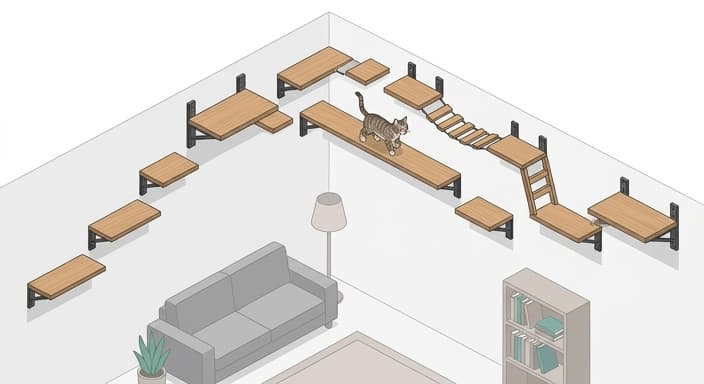
Many behavioral issues, such as inter-cat aggression or persistent scratching of the sofa, can be traced back to a lack of "territorial equity." In a vertical-deficient home, the cat with the most confidence often claims the floor, forcing the more timid cat into a state of perpetual anxiety. Shelving systems act as a "spatial equalizer." When you install a series of platforms that allow a cat to traverse a room without ever touching the ground, you provide a non-confrontational path that allows cats to share space without the pressure of direct physical interaction.
Furthermore, vertical shelving provides the "environmental enrichment" that is so frequently missing in indoor lifestyles. A cat that can jump, climb, and perch is a cat that is physically and mentally exhausted in the best possible way. This engagement reduces the likelihood of destructive behaviors that stem from boredom. When a cat has a "cat highway" that spans the upper perimeter of a living room, they are essentially patrolling their territory, which satisfies their natural instinct to monitor their domain.
Essential Design Principles: Safety and Ergonomics
Before you begin drilling into your drywall, it is vital to approach vertical installations with the same precision you would use for a piece of veterinary medical equipment. The primary concern here is joint health and safety. I often see "DIY" shelves that are too slick, too far apart, or improperly anchored, which can lead to slips, falls, and orthopedic injuries—particularly in senior cats or those with early-stage arthritis.
When designing your wall system, keep these three clinical "must-haves" in mind:
- Surface Traction: A shelf made of polished wood or laminate is a hazard. Cats rely on their claws for stability during jumps. Always cover shelves with high-friction material like industrial-grade carpet squares, sisal, or non-slip rubber mats. This is especially critical for aging cats who may have reduced proprioception.
- The "Landing Zone" Gap: For a healthy, adult cat, the distance between shelves should be roughly 12 to 18 inches. If you have a senior cat, these gaps should be smaller, or you should include "step-down" platforms to reduce the impact of their descent. Constant jumping from high surfaces to hard floors is a leading cause of long-term joint inflammation and micro-trauma to the wrists (carpals) and shoulders.
- Load-Bearing Integrity: Always mount your shelves directly into wall studs. A cat that jumps at full speed can exert a significant amount of force on a shelf. If a shelf wobbles or pulls away from the wall, your cat will likely never use it again due to the "negative association" of the unstable surface.
Integrating Enrichment into the "Cat Highway"
Once the structural foundation is secure, you can elevate the experience by curating the vertical space to serve different feline needs. Think of your wall system as having "zones." Some shelves should be high-altitude observation posts—these are perfect for a window-facing wall where the cat can engage in the "bird-watching" that is so essential for mental stimulation. Other areas should be designated as "cozy retreats," featuring cubbies or soft, enclosed beds where the cat can hide away from the noise of the house.
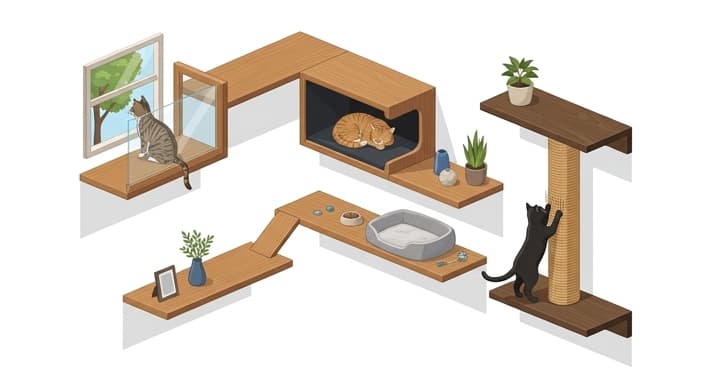
I also recommend incorporating "scratching nodes" into your vertical design. Cats have a natural urge to stretch their spine and shed their nail sheaths after a nap. By mounting a piece of sisal-wrapped post or a vertical scratch pad at the end of a shelf, you are rewarding the cat for moving through their environment. It turns a simple walk across the wall into a ritualized, satisfying activity that keeps their muscles toned and their anxiety levels low.
The Long-Term Health Benefits of Elevation
As a veterinarian, my goal is always to keep the patient out of the clinic, and vertical shelving is a powerful, non-pharmaceutical tool for doing just that. A cat that remains active into their senior years is significantly less likely to suffer from the muscle atrophy associated with sedentary living. By encouraging vertical movement, you are maintaining your cat’s flexibility, balance, and core strength, which act as a natural brace for their joints as they age.
Moreover, the psychological benefits of elevated territory cannot be overstated. A cat that feels in control of their environment is a cat with a stronger immune system. Stress is a major immunosuppressant in felines; by providing a safe, high-altitude sanctuary, you are actively reducing the cortisol levels that, over time, can contribute to chronic illness. Investing in your walls is, quite literally, investing in your cat’s long-term vitality.
In conclusion, transitioning to a vertical-friendly home is one of the most impactful changes you can make for your cat’s well-being. By moving beyond the flat-floor paradigm and embracing the three-dimensional nature of our feline companions, we provide them with the security, exercise, and mental stimulation they need to thrive. Whether you start with a single floating shelf or a complex wall-spanning highway, remember that the goal is to create a space that respects their instinctual architecture. When we give them the room to climb, we give them the freedom to be the confident, healthy, and happy cats they were always meant to be.
Common Questions
🤔
Frequently Asked Questions
What are the core benefits of vertical wall shelving for indoor cats?▼
Vertical wall shelving aligns with the cat's ancestral need to be elevated, giving them access to vantage points and safe retreat. It expands their three dimensional space beyond the floor, promoting physical exercise and mental engagement. Properly positioned shelves can reduce boredom and destructive scratching by channeling predatory and territorial instincts into appropriate outlets. When designed with safety in mind, vertical shelving becomes a durable enrichment feature rather than a decorative accessory.
What design and installation considerations ensure safety and ergonomics?▼
Safety and ergonomics should guide every stage of design and installation. Use anchors rated for the wall type and install shelves into studs or use heavy duty toggles for drywall; ensure all joints are secure and check weight limits. Select non slip surfaces and rounded edges to minimize injuries, and space the levels within a cat's reach to prevent jumps from being too high. Consider your cat's age and mobility, opting for gradual ramps or wider perches for arthritic or senior cats.
How can vertical shelving help reduce behavioral conflicts in multi-cat homes?▼
Vertical shelving can serve as a non confrontational path for sharing space, reducing direct encounters that trigger aggression. A defined network lets cats patrol and monitor their territory from different elevations, creating a sense of territory fairness. It also provides outlets for chase, stalking, and climbing that can decrease overgrooming and furniture scratching caused by boredom. In multi-cat homes, the presence of independent routes helps timid cats avoid constant confrontation while still belonging to the group.
How should a new vertical wall system be introduced into a home and what are first steps?▼
Start with a plan that maps cat routes and traffic flow, then install a small starter kit to test how your cats respond. Begin by anchoring a few sturdy shelves at moderate heights, using studs or appropriate wall anchors and ensuring secure, non slip surfaces. Introduce the system gradually with treats and play sessions near the shelves to encourage exploration, and monitor for signs of stress or hesitancy. Expand the network in stages only after your cats consistently use the initial shelves and show no signs of neck or joint strain.